



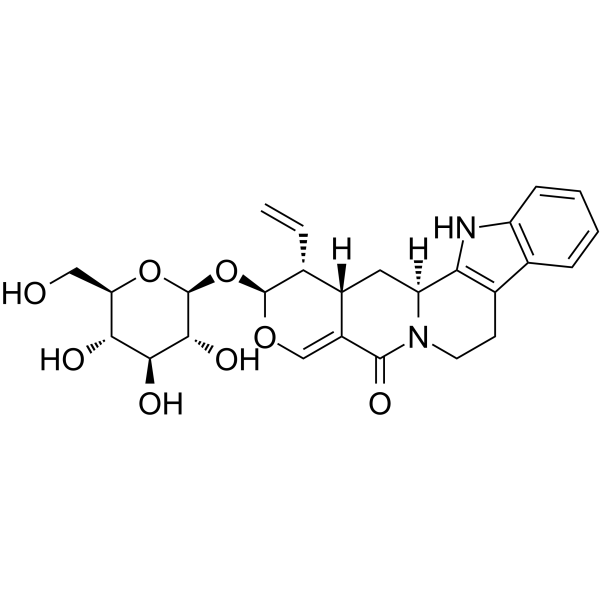
Strictosamide

Based on 1 Customer Validation
Strictosamide is a compound that can be isolated from Nauclea officinalis. Strictosamide has various activities such as anti-inflammatory, analgesic, anti-Plasmodium, antifungal, and promoting wound healing.
Nur für Forschungszwecke. Wir verkaufen nicht an Patienten.
- Reinheit : 99.94%
- CAS. Nr.: 23141-25-5
- Formel: C26H30N2O8
- Molecular Weight:498.53
-
Speicherung:
4°C, protect from light
* In solvent : -80°C, 6 months; -20°C, 1 month (protect from light)

To place orders, for customer services and technical support, please contact: MedChemExpress USA
Tel: 609-228-6898 E-mail: [email protected] [email protected]


-
 Biologische Aktivität
-
Chemical Information
-
Lösungsmittel & Löslichkeit
- Protokoll
- Reinheit & Dokumentation
- Verweise
-
 Help & FAQs


Alle Parasite Isoform-spezifische Produkte anzeigen
More

Biologische Aktivität
Beschreibung
Cellular Effect
|
Cell Line

|
Type | Value | Description | References |
|---|---|---|---|---|
| A549 | IC50 |
>80 μM
Compound: 21
|
Cytotoxicity against human A549 cells assessed as cell growth inhibition measured after 48 hrs by MTT assay
Cytotoxicity against human A549 cells assessed as cell growth inhibition measured after 48 hrs by MTT assay
|
[PMID: 31804070] |
| HepG2 | IC50 |
>80 μM
Compound: 21
|
Cytotoxicity against human HepG2 cells assessed as cell growth inhibition measured after 48 hrs by MTT assay
Cytotoxicity against human HepG2 cells assessed as cell growth inhibition measured after 48 hrs by MTT assay
|
[PMID: 31804070] |
| MCF7 | IC50 |
>80 μM
Compound: 21
|
Cytotoxicity against human MCF7 cells assessed as cell growth inhibition measured after 48 hrs by MTT assay
Cytotoxicity against human MCF7 cells assessed as cell growth inhibition measured after 48 hrs by MTT assay
|
[PMID: 31804070] |
In Vitro
Strictosamide (0-200 μM; 24 h) can inhibit the production of NO, TNF-α, and IL-1β, as well as the expression of iNOS in LPS (HY-D1056)-treated RAW 264.7 cells. The mechanism involves the inhibition of the NF-κB and MAPK pathways[1].
Strictosamide (0.25-2 mg/mL) can inhibit the Mg2+-ATPase activity in isolated kidneys[2].
MedChemExpress (MCE) has not independently confirmed the accuracy of these methods. They are for reference only.
-
Cell Line:LPS (HY-D1056)-treated RAW 264.7 cells
-
Concentration:0, 25, 50, 100 and 200 µM
-
Incubation Time:24 h
-
Result:Markedly decreased the expressions of p-p65, p-IκBα and p-IKKα in NF-κB signaling pathways.
Significantly decreased the phosphorylation of p38, ERK and JNK in MAPK signaling pathways.
In Vivo
Strictosamide (10-40 mg/kg; intravenous injection; twice a day; 3 days) has anti-inflammatory and analgesic effects in multiple mouse models[3].
Strictosamide (0.5-1.5 mg/kg; topical application; twice a day; 8 days) has a wound-healing-promoting effect in a rat wound model. The mechanism involves the activation of the PI3K/AKT signaling pathway[4].
MedChemExpress (MCE) has not independently confirmed the accuracy of these methods. They are for reference only.
-
Animal Model:ICR mice, weighing 18-22 g[3]
-
Dosage:10, 20 and 40 mg/kg
-
Administration:Intravenous injection; twice a day; 3 days
-
Result:Obviously decreased the 12-O-tetradecanoylphorbol-13-acetate (TPA)-induced mice ear edema (24.7 and 28.1% inhibition, respectively) at 20 and 40 mg/kg.
Significantly inhibited acetic acid (HY-Y0319)-stimulated peritoneal vascular permeability in mice (23.3 and 33.4% inhibition, respectively) at 20 and 40 mg/kg.
Significantly decreased the leukocytes in the mice peritoneal cavity induced by CMC–Na at all the tested doses (46.0, 49.1, and 58.7% inhibition, respectively).
Markedly prolonged the pain latency at 20 and 40 mg/kg and decreased the writhing counts at 40 mg/kg (49.7% inhibition) in acetic acid (HY-Y0319)-induced writhing test in mice. However, it did not obviously improve the pain threshold of mice in hot-plate test.
-
Animal Model:Male Sprague Dawley (SD) rats (200-220 g) with skin wound model[4]
-
Dosage:0.5 and 1.5 mg/kg
-
Administration:Topical application; twice a day; 8 days
-
Result:Promoted wound healing.
Reduced inflammatory infiltration.
Enhanced collagen deposition.
Upregulated the expression of CD31 and PCNA


Chemical Information
-
CAS. Nr. 23141-25-5
-
Appearance Solid
-
Molecular Weight 498.53
-
Formel C26H30N2O8
-
Color Off-white to yellow
-
SMILES
O=C1N2CCC3=C(NC4=C3C=CC=C4)[C@]2([H])C[C@]5([H])C1=CO[C@@H](O[C@H]6[C@@H]([C@H]([C@@H]([C@@H](CO)O6)O)O)O)[C@@H]5C=C
-
Structure Classification
-
Initial Source
-
Versand
Room temperature in continental US; may vary elsewhere.
-
Speicherung
4°C, protect from light
* In solvent : -80°C, 6 months; -20°C, 1 month (protect from light)


Lösungsmittel & Löslichkeit
In Vitro:
DMSO : 100 mg/mL (200.59 mM; Need ultrasonic; Hygroscopic DMSO has a significant impact on the solubility of product, please use newly opened DMSO)
Please refer to the solubility information to select the appropriate solvent. Once prepared, please aliquot and store the solution to prevent product inactivation from repeated freeze-thaw cycles.
Storage method and period of stock solution: -80°C, 6 months; -20°C, 1 month (protect from light). When stored at -80°C, please use it within 6 months. When stored at -20°C, please use it within 1 month.
Please refer to the solubility information to select the appropriate solvent. Once prepared, please aliquot and store the solution to prevent product inactivation from repeated freeze-thaw cycles.
Storage method and period of stock solution: -80°C, 6 months; -20°C, 1 month (protect from light). When stored at -80°C, please use it within 6 months. When stored at -20°C, please use it within 1 month.
Konzentration (Stammlösung) × Volumen (Stammlösung) = Konzentration (Ziellösung) × Volumen (Ziellösung)
In Vivo:
Select the appropriate dissolution method based on your experimental animal and administration route.
- For the following dissolution methods, please ensure to first prepare a clear stock solution using an In Vitro approach and then sequentially add co-solvents:
- To ensure reliable experimental results, the clarified stock solution can be appropriately stored based on storage conditions. As for the working solution for In Vivo experiments, it is recommended to prepare freshly and use it on the same day.
- The percentages shown for the solvents indicate their volumetric ratio in the final prepared solution. If precipitation or phase separation occurs during preparation, heat and/or sonication can be used to aid dissolution.
Add each solvent one by one: 10% DMSO 40% PEG300 5% Tween-80 45% Saline
Solubility: ≥ 2.5 mg/mL (5.01 mM); Clear solution
This protocol yields a clear solution of ≥ 2.5 mg/mL (saturation unknown).
Taking 1 mL working solution as an example, add 100 μL DMSO stock solution (25.0 mg/mL) to 400 μL PEG300, and mix evenly; then add 50 μL Tween-80 and mix evenly; then add 450 μL Saline to adjust the volume to 1 mL.
Preparation of Saline: Dissolve 0.9 g sodium chloride in ddH₂O and dilute to 100 mL to obtain a clear Saline solution.
Add each solvent one by one: 10% DMSO 90% (20% SBE-β-CD in Saline)
Solubility: ≥ 2.5 mg/mL (5.01 mM); Clear solution
This protocol yields a clear solution of ≥ 2.5 mg/mL (saturation unknown).
Taking 1 mL working solution as an example, add 100 μL DMSO stock solution (25.0 mg/mL) to 900 μL 20% SBE-β-CD in Saline, and mix evenly.
Preparation of 20% SBE-β-CD in Saline (4°C, storage for one week): 2 g SBE-β-CD powder is dissolved in 10 mL Saline, completely dissolve until clear.
In Vivo Dissolution Calculator
Please enter the basic information of animal experiments:
-
-
-
-
Recommended: Prepare an additional quantity of animals to account for potential losses during experiments.
Please enter your animal formula composition:
-
%DMSO +
Recommended: Keep the proportion of DMSO in working solution below 2% if your animal is weak.
-
%+
-
+%Tween-80 + +
-
%Saline +
The co-solvents required include: DMSO, . All of co-solvents are available by MedChemExpress (MCE). , Tween 80. All of co-solvents are available by MedChemExpress (MCE).
Working solution concentration: 0.22 mg/mL
Method for preparing stock solution: mg drug dissolved in μL DMSO. Stock solution concentration: mg/mL. * In solvent : -80°C, 6 months; -20°C, 1 month (protect from light)
1. Take μL DMSO stock solution;
2. Add μL .
μL , mix evenly;
3. Then add μL Tween 80, mix evenly;
4. Then add μL
Please ensure that the stock solution in the first step is dissolved to a clear state, and add co-solvents in sequence. You can use ultrasonic heating (ultrasonic cleaner, recommended frequency 20-40 kHz), vortexing, etc. to assist dissolution.


Reinheit & Dokumentation
-
Data Sheet (291 KB)
-
SDS (252 KB)
- English - EN (252 KB)
- Français - FR (252 KB)
- Deutsch - DE (252 KB)
- Norwegian - NO (252 KB)
- Español - ES (252 KB)
- Swedish - SV (252 KB)
- Italian - IT (252 KB)
- Korean - KR (252 KB)
- Portuguese - PT (252 KB)
-
Handling Instructions (2659 KB)
Verweise
[1]. Li D, et al. Anti-inflammatory effect of the six compounds isolated from Nauclea officinalis Pierrc ex Pitard, and molecular mechanism of strictosamide via suppressing the NF-κB and MAPK signaling pathway in LPS-induced RAW 264.7 macrophages. J Ethnopharmacol. 2017 Jan 20;196:66-74. [Content Brief]
[2]. Candeias MF, et al. Effects of strictosamide on mouse brain and kidney Na+, K+-ATPase and Mg2+-ATPase activities. J Ethnopharmacol. 2009 Jan 12;121(1):117-22. [Content Brief]
[3]. Na Li, et al. In vivo anti-inflammatory and analgesic activities of strictosamide from Nauclea officinalis. Pharm Biol. 2014 Nov;52(11):1445-50. [Content Brief]
[4]. Ming GX, et al. Strictosamide promotes wound healing through activation of the PI3K/AKT pathway. Heliyon. 2024 Apr 23;10(9):e30169. [Content Brief]


Complete Stock Solution Preparation Table
Please refer to the solubility information to select the appropriate solvent. Once prepared, please aliquot and store the solution to prevent product inactivation from repeated freeze-thaw cycles.
Storage method and period of stock solution: -80°C, 6 months; -20°C, 1 month (protect from light). When stored at -80°C, please use it within 6 months. When stored at -20°C, please use it within 1 month.
| Optional Solvent | Concentration Solvent Mass | 1 mg | 5 mg | 10 mg | 25 mg |
|---|---|---|---|---|---|
| DMSO | 1 mM | 2.0059 mL | 10.0295 mL | 20.0590 mL | 50.1474 mL |
| 5 mM | 0.4012 mL | 2.0059 mL | 4.0118 mL | 10.0295 mL | |
| 10 mM | 0.2006 mL | 1.0029 mL | 2.0059 mL | 5.0147 mL | |
| 15 mM | 0.1337 mL | 0.6686 mL | 1.3373 mL | 3.3432 mL | |
| 20 mM | 0.1003 mL | 0.5015 mL | 1.0029 mL | 2.5074 mL | |
| 25 mM | 0.0802 mL | 0.4012 mL | 0.8024 mL | 2.0059 mL | |
| 30 mM | 0.0669 mL | 0.3343 mL | 0.6686 mL | 1.6716 mL | |
| 40 mM | 0.0501 mL | 0.2507 mL | 0.5015 mL | 1.2537 mL | |
| 50 mM | 0.0401 mL | 0.2006 mL | 0.4012 mL | 1.0029 mL | |
| 60 mM | 0.0334 mL | 0.1672 mL | 0.3343 mL | 0.8358 mL | |
| 80 mM | 0.0251 mL | 0.1254 mL | 0.2507 mL | 0.6268 mL | |
| 100 mM | 0.0201 mL | 0.1003 mL | 0.2006 mL | 0.5015 mL |


Strictosamide Related Classifications
HY-N1198 Related Classifications
 Powered by Bioz