



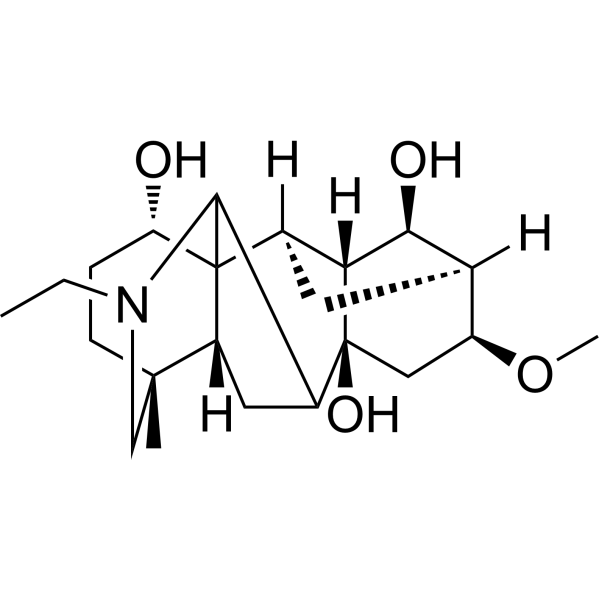
Karacoline

Based on 1 Customer Validation
Karacoline is an orally active PPARγ activator and ERK/JNK MAPK inhibitor. Karacoline restricts ROS production, maintains mitochondrial membrane potential, and inhibits pulmonary cell apoptosis. Karacoline inhibits NF-κB pathway activation, reduces acetylation levels of p65 and the expression of MMP14 and MMP9, enhances the expression of type II collagen (collagen II) and aggrecan (aggrecan), and suppresses extracellular matrix degradation. In a mouse model of sepsis-induced acute lung injury, Karacoline alleviates lung injury, inhibits the release of IL-1β, IL-6 and TNF-α, increases the Bcl-2/BAX ratio, and reduces caspase 3 expression. Karacoline can be used in research related to acute lung injury and intervertebral disc degeneration.
For research use only. We do not sell to patients.
- Purity: 99.58%
- CAS No.: 39089-30-0
- Formula: C22H35NO4
- Molecular Weight:377.52
-
Storage:
4°C, protect from light
* In solvent : -80°C, 6 months; -20°C, 1 month (protect from light)

To place orders, for customer services and technical support, please contact: MedChemExpress USA
Tel: 609-228-6898 E-mail: [email protected] [email protected]


-
 Biological Activity
-
Chemical Information
-
Solvent & Solubility
- Purity & Documentation
- References
-
 Help & FAQs


All Caspase Isoforms
More

Biological Activity
Description
|
PPARγ |
MMP9 |
MMP14 |
IL-1β |
IL-6 |
Caspase 3 |
TNF-α |
In Vitro
Karacoline (1.6 μM; 24 h) inhibits LPS (HY-D1056)-induced apoptosis of MH-S cells by reducing ROS production and maintaining the stability of mitochondrial membrane potential[1].
Karacoline (1.6 μM; 24 h) upregulates the expression of PPARγ in LPS-stimulated MH-S cells, inhibits the JNK/ERK MAPK signaling pathway (excluding p38), and simultaneously suppresses the expression of MMP9[1].
Karacoline (0.001-1000.0 μM; 24 h) has an IC50 of 6.444 μM in primary rat nucleus pulposus cells, and Karacoline (1.25 μM; 0-3 days) partially reverses TNF-α-induced cytotoxicity in these cells[2].
Karacoline (1.25-12.88 μM; 24 h) reverses TNF-α-induced changes in gene expression in primary rat nucleus pulposus cells, downregulates MMP-14 expression and upregulates type II collagen expression, while the 1.25 μM concentration also upregulates aggrecan expression[2].
Karacoline (1.25-12.88 μM; 48 h) reverses TNF-α-induced extracellular matrix degradation in primary rat nucleus pulposus cells and increases aggrecan secretion; at the concentration of 1.25 μM, it also increases type II collagen secretion and reduces MMP-14 secretion[2].
Karacoline (1.25-12.88 μM; 4 days) increases the levels of type II collagen and proteoglycan, and decreases the level of MMP-14, in primary rat nucleus pulposus cells treated with TNF-α[2].
Karacoline (1.25 μM-12.88 μM; 24-48 h) reduces TNF-α-induced MMP-14 protein expression and inhibits the activation of the NF-κB pathway in primary rat nucleus pulposus cells by decreasing the acetylation level of p65[2].
Karacoline (1.25-12.88 μM; 48 h) reduces TNF-α-induced apoptosis in primary rat nucleus pulposus cells[2].
MedChemExpress (MCE) has not independently confirmed the accuracy of these methods. They are for reference only.
-
Cell Line:LPS-stimulated MH-S murine alveolar macrophages
-
Concentration:1.6 μM
-
Incubation Time:24 h
-
Result:Attenuated LPS-induced apoptosis, as shown by reduced cleaved caspase-3 expression, increased Bcl-2/BAX ratio, and decreased proportion of apoptotic cells.
Reduced LPS-induced intracellular ROS fluorescence intensity.
Reversed LPS-mediated MMP loss (restored red/green fluorescence ratio).
-
Cell Line:primary rat nucleus pulposus cells
-
Concentration:0, 1.25, 12.88 μM+100 ng/mL TNF-α
-
Incubation Time:24 h
-
Result:Reduced MMP-14 expression and increased collagen II expression, with 1.25 μM also increasing aggrecan expression.
-
Cell Line:primary rat nucleus pulposus cells
-
Concentration:0, 1.25, 12.88 μM+100 ng/mL TNF-α
-
Incubation Time:48 h
-
Result:Reduced TNF-α-induced MMP-14 protein expression.
-
Cell Line:primary rat nucleus pulposus cells
-
Concentration:0, 1.25, 12.88 μM+100 ng/mL TNF-α
-
Incubation Time:4 days
-
Result:Increased collagen II and aggrecan levels and reduced MMP-14 levels.
In Vivo
MedChemExpress (MCE) has not independently confirmed the accuracy of these methods. They are for reference only.
-
Animal Model:C57BL/6 (male, 6-8 weeks old, 20-25 g, sepsis-induced acute lung injury via CLP surgery)[1]
-
Dosage:10 mg/kg (survival monitoring); 20 mg/kg; 40 mg/kg (survival monitoring)
-
Administration:i.g. (single dose for survival monitoring); i.g. (1 h before surgery and 12 h after surgery)
-
Result:Improved 7-day survival of CLP-induced septic mice at 20 mg/kg and 10 mg/kg (40 mg/kg did not improve survival beyond 20 mg/kg).
Reduced lung wet-to-dry weight ratio at 20 mg/kg.
Decreased total protein and albumin levels in bronchoalveolar lavage fluid (BALF) at 20 mg/kg.
Lowered BALF concentrations of IL-1β, IL-6, and TNF-α at 20 mg/kg.
Reduced lung injury scores at 20 mg/kg.
Mitigated histopathological changes including alveolar disruption, interstitial edema, and inflammatory cell infiltration at 20 mg/kg.
Increased the Bcl-2/BAX ratio in lung tissue at 20 mg/kg.
Decreased cleaved-caspase-3 levels in lung tissue at 20 mg/kg.
Reduced BAX expression in lung tissue at 20 mg/kg.
Increased Bcl-2 expression in lung tissue at 20 mg/kg.
Lowered TUNEL-positive cell counts in lung tissue at 20 mg/kg.
Restored PPARγ mRNA and protein expression in lung tissue at 20 mg/kg.
Suppressed phosphorylation of JNK and ERK in lung tissue at 20 mg/kg.
Reduced MMP9 expression in lung tissue at 20 mg/kg.


Chemical Information
-
CAS No. 39089-30-0
-
Appearance Solid
-
Molecular Weight 377.52
-
Formula C22H35NO4
-
Color White to off-white
-
SMILES
O[C@@H]1C23C4C([C@]5(O)[C@]6([H])[C@@]3([H])C[C@@]([C@@H](OC)C5)([H])[C@@H]6O)C[C@]2([H])[C@@](CN4CC)(C)CC1
-
Structure Classification
-
Initial Source
-
Shipping
Room temperature in continental US; may vary elsewhere.
-
Storage
4°C, protect from light
* In solvent : -80°C, 6 months; -20°C, 1 month (protect from light)


Solvent & Solubility
In Vitro:
DMSO : 25 mg/mL (66.22 mM; Need ultrasonic; Hygroscopic DMSO has a significant impact on the solubility of product, please use newly opened DMSO)
Please refer to the solubility information to select the appropriate solvent. Once prepared, please aliquot and store the solution to prevent product inactivation from repeated freeze-thaw cycles.
Storage method and period of stock solution: -80°C, 6 months; -20°C, 1 month (protect from light). When stored at -80°C, please use it within 6 months. When stored at -20°C, please use it within 1 month.
Please refer to the solubility information to select the appropriate solvent. Once prepared, please aliquot and store the solution to prevent product inactivation from repeated freeze-thaw cycles.
Storage method and period of stock solution: -80°C, 6 months; -20°C, 1 month (protect from light). When stored at -80°C, please use it within 6 months. When stored at -20°C, please use it within 1 month.
Concentration (start) × Volume (start) = Concentration (final) × Volume (final)
In Vivo:
Select the appropriate dissolution method based on your experimental animal and administration route.
- For the following dissolution methods, please ensure to first prepare a clear stock solution using an In Vitro approach and then sequentially add co-solvents:
- To ensure reliable experimental results, the clarified stock solution can be appropriately stored based on storage conditions. As for the working solution for In Vivo experiments, it is recommended to prepare freshly and use it on the same day.
- The percentages shown for the solvents indicate their volumetric ratio in the final prepared solution. If precipitation or phase separation occurs during preparation, heat and/or sonication can be used to aid dissolution.
Add each solvent one by one: 10% DMSO 40% PEG300 5% Tween-80 45% Saline
Solubility: ≥ 2.5 mg/mL (6.62 mM); Clear solution
This protocol yields a clear solution of ≥ 2.5 mg/mL (saturation unknown).
Taking 1 mL working solution as an example, add 100 μL DMSO stock solution (25.0 mg/mL) to 400 μL PEG300, and mix evenly; then add 50 μL Tween-80 and mix evenly; then add 450 μL Saline to adjust the volume to 1 mL.
Preparation of Saline: Dissolve 0.9 g sodium chloride in ddH₂O and dilute to 100 mL to obtain a clear Saline solution.
Add each solvent one by one: 10% DMSO 90% (20% SBE-β-CD in Saline)
Solubility: ≥ 2.5 mg/mL (6.62 mM); Clear solution
This protocol yields a clear solution of ≥ 2.5 mg/mL (saturation unknown).
Taking 1 mL working solution as an example, add 100 μL DMSO stock solution (25.0 mg/mL) to 900 μL 20% SBE-β-CD in Saline, and mix evenly.
Preparation of 20% SBE-β-CD in Saline (4°C, storage for one week): 2 g SBE-β-CD powder is dissolved in 10 mL Saline, completely dissolve until clear.
In Vivo Dissolution Calculator
Please enter the basic information of animal experiments:
-
-
-
-
Recommended: Prepare an additional quantity of animals to account for potential losses during experiments.
Please enter your animal formula composition:
-
%DMSO +
Recommended: Keep the proportion of DMSO in working solution below 2% if your animal is weak.
-
%+
-
+%Tween-80 + +
-
%Saline +
The co-solvents required include: DMSO, . All of co-solvents are available by MedChemExpress (MCE). , Tween 80. All of co-solvents are available by MedChemExpress (MCE).
Working solution concentration: 0.22 mg/mL
Method for preparing stock solution: mg drug dissolved in μL DMSO. Stock solution concentration: mg/mL. * In solvent : -80°C, 6 months; -20°C, 1 month (protect from light)
1. Take μL DMSO stock solution;
2. Add μL .
μL , mix evenly;
3. Then add μL Tween 80, mix evenly;
4. Then add μL
Please ensure that the stock solution in the first step is dissolved to a clear state, and add co-solvents in sequence. You can use ultrasonic heating (ultrasonic cleaner, recommended frequency 20-40 kHz), vortexing, etc. to assist dissolution.


Purity & Documentation
-
Data Sheet (288 KB)
-
SDS (252 KB)
- English - EN (252 KB)
- Français - FR (252 KB)
- Deutsch - DE (252 KB)
- Norwegian - NO (252 KB)
- Español - ES (252 KB)
- Swedish - SV (252 KB)
- Italian - IT (252 KB)
- Korean - KR (252 KB)
- Portuguese - PT (252 KB)
-
Handling Instructions (2659 KB)
References
[1]. Lei Z, et al. Karacoline attenuates sepsis-induced acute lung injury by suppressing apoptosis via PPARγ-associated inhibition of JNK/ERK MAPK signaling. Respiratory research. 2026 Jun 15. [Content Brief]
[2]. Zhou X, et al. Karacoline, identified by network pharmacology, reduces degradation of the extracellular matrix in intervertebral disc degeneration via the NF-κB signaling pathway. Journal of pharmaceutical analysis. 2020 Feb;10(1):13-22. [Content Brief]


Complete Stock Solution Preparation Table
Please refer to the solubility information to select the appropriate solvent. Once prepared, please aliquot and store the solution to prevent product inactivation from repeated freeze-thaw cycles.
Storage method and period of stock solution: -80°C, 6 months; -20°C, 1 month (protect from light). When stored at -80°C, please use it within 6 months. When stored at -20°C, please use it within 1 month.
| Optional Solvent | Concentration Solvent Mass | 1 mg | 5 mg | 10 mg | 25 mg |
|---|---|---|---|---|---|
| DMSO | 1 mM | 2.6489 mL | 13.2443 mL | 26.4887 mL | 66.2217 mL |
| 5 mM | 0.5298 mL | 2.6489 mL | 5.2977 mL | 13.2443 mL | |
| 10 mM | 0.2649 mL | 1.3244 mL | 2.6489 mL | 6.6222 mL | |
| 15 mM | 0.1766 mL | 0.8830 mL | 1.7659 mL | 4.4148 mL | |
| 20 mM | 0.1324 mL | 0.6622 mL | 1.3244 mL | 3.3111 mL | |
| 25 mM | 0.1060 mL | 0.5298 mL | 1.0595 mL | 2.6489 mL | |
| 30 mM | 0.0883 mL | 0.4415 mL | 0.8830 mL | 2.2074 mL | |
| 40 mM | 0.0662 mL | 0.3311 mL | 0.6622 mL | 1.6555 mL | |
| 50 mM | 0.0530 mL | 0.2649 mL | 0.5298 mL | 1.3244 mL | |
| 60 mM | 0.0441 mL | 0.2207 mL | 0.4415 mL | 1.1037 mL |


Karacoline Related Classifications
HY-N6812 Related Classifications
 Powered by Bioz
Keywords
- Karacoline
- 39089-30-0
- NF-κB
- PPAR
- ERK
- JNK
- p38 MAPK
- Reactive Oxygen Species (ROS)
- Apoptosis
- MMP
- Collagen
- Interleukin Related
- Bcl-2 Family
- Caspase
- TNF Receptor
- male C57BL/6 mice
- ERK/JNK MAPK
- intervertebral disc degeneration
- MH-S cells
- PPARγ
- NF-κB pathway
- mitochondrial membrane potential
- sepsis-induced acute lung injury
- ROS
- primary rat nucleus pulposus cells
- Inhibitor
- inhibitor
- inhibit