



WK369

Based on 1 Customer Validation
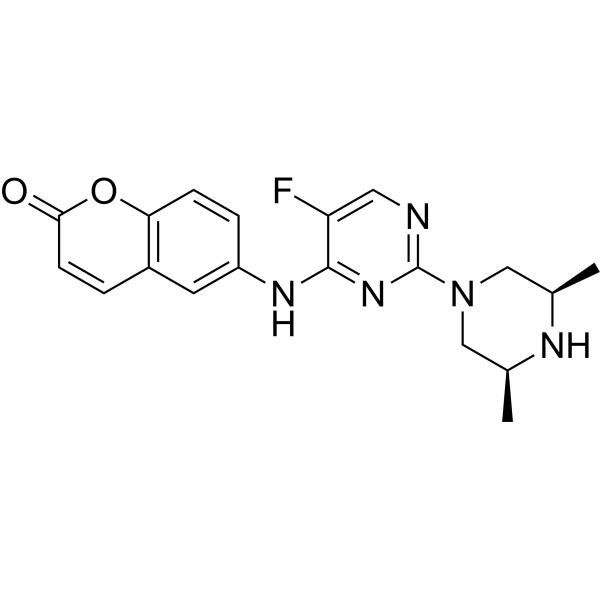
WK369 is a BCL6 inhibitor with a Kd of 2.24 μM for binding to the BCL6-BTB domain. WK369 exhibits potent anti-ovarian cancer activity. WK369 blocks the BCL6-BTB-SMRT interaction (IC50 = 0.32 μM), relieves BCL6-mediated transcriptional repression, reactivates p53, ATR, and CDKN1A, induces S-phase arrest, apoptosis, and DNA damage response, downregulates CyclinB1 and CyclinD1, activates PARP, and inhibits AKT and MEK/ERK phosphorylation. WK369 shows synergistic effects with Cisplatin (HY-17394). WK369 can be used for research on ovarian cancer.
Nur für Forschungszwecke. Wir verkaufen nicht an Patienten.
- Reinheit : 99.89%
- Formel: C19H20FN5O2
- Molecular Weight:369.39
-
Speicherung:Powder -20°C, 3 years , 4°C, 2 years ; In solvent -80°C, 6 months , -20°C, 1 month

To place orders, for customer services and technical support, please contact: MedChemExpress USA
Tel: 609-228-6898 E-mail: [email protected] [email protected]


-
 Biologische Aktivität
-
Chemical Information
-
Lösungsmittel & Löslichkeit
- Protokoll
- Reinheit & Dokumentation
- Verweise
-
 Help & FAQs




Biologische Aktivität
Beschreibung
IC50 & Target
[1]|
BCL6-BTB 2.24 μM (Kd) |
ERK |
ATR |
Akt |
CyclinB1 |
CyclinD1 |
Cellular Effect
|
Cell Line

|
Type | Value | Description | References |
|---|---|---|---|---|
| ES-2 | IC50 |
1.3 μM
|
Antiproliferative activity against human ES-2 cells assessed as viability reduction incubated 72 hrs by MTS assay.
Antiproliferative activity against human ES-2 cells assessed as viability reduction incubated 72 hrs by MTS assay.
|
38169532 |
| SK-OV-3 | IC50 |
1.7 μM
|
Antiproliferative activity against human SKOV3 cells assessed as viability reduction incubated 72 hrs by MTS assay.
Antiproliferative activity against human SKOV3 cells assessed as viability reduction incubated 72 hrs by MTS assay.
|
38169532 |
| Caov-3 cell line | IC50 |
4.8 μM
|
Antiproliferative activity against human CAOV3 cells assessed as viability reduction incubated 72 hrs by MTS assay.
Antiproliferative activity against human CAOV3 cells assessed as viability reduction incubated 72 hrs by MTS assay.
|
38169532 |
| OVCAR-8 | IC50 |
6.8 μM
|
Antiproliferative activity against human OVCAR8 cells assessed as viability reduction incubated 72 hrs by MTS assay.
Antiproliferative activity against human OVCAR8 cells assessed as viability reduction incubated 72 hrs by MTS assay.
|
38169532 |
| IGROV-1 | IC50 |
22.8 μM
|
Antiproliferative activity against human IGROV-1 cells assessed as viability reduction incubated 72 hrs by MTS assay.
Antiproliferative activity against human IGROV-1 cells assessed as viability reduction incubated 72 hrs by MTS assay.
|
38169532 |
| HaCaT | IC50 |
42.9 μM
|
Antiproliferative activity against human HaCaT cells assessed as viability reduction incubated 72 hrs by MTS assay.
Antiproliferative activity against human HaCaT cells assessed as viability reduction incubated 72 hrs by MTS assay.
|
38169532 |
| HEK-293T | IC50 |
36.9 μM
|
Antiproliferative activity against human 293T cells assessed as viability reduction incubated 72 hrs by MTS assay.
Antiproliferative activity against human 293T cells assessed as viability reduction incubated 72 hrs by MTS assay.
|
38169532 |
In Vitro
WK369 (up to 100 μM; 72 h) exhibits significant cytotoxicity in BCL6-expressing ovarian cancer cells such as ES-2, SKOV3, MCAS, OVCAR8, and CAOV3, with IC50 values of 1.3, 1.7, 2.5, 4.8, and 6.8 μM, respectively, whereas it has weak effects in BCL6-negative IGROV-1 and normal cell lines (293T, HaCaT), with IC50 values of 22.8, 36.9, and 42.9 μM, respectively[1].
WK369 (0.625-5 μM; 72 h) shows significantly reduced antiproliferative activity in BCL6-knockdown ES-2 and SKOV3 cells, confirming its target dependence[1].
WK369 (1-5 μM; 24 h-7 days) significantly inhibits colony formation as well as in vitro migration and invasion in ES-2 and SKOV3 cells[1].
WK369 (72 h-12 days) combined with Cisplatin exposure synergistically inhibits cell proliferation and colony formation in ES-2 and SKOV3 cell lines[1].
WK369 (24 h) inhibits AKT and MEK/ERK phosphorylation activation in a concentration-dependent manner in ES-2 and SKOV3 cells[1].
MedChemExpress (MCE) has not independently confirmed the accuracy of these methods. They are for reference only.
-
Cell Line:Farage cells
-
Concentration:1.25, 2.5, 5, 10, 20 μM
-
Incubation Time:24 h
-
Result:Reactivated ATR, p53, CDKN1A, and CD69 in a concentration-dependent manner, with the largest increases at 20 μM.
-
Cell Line:ES-2 and SKOV3 cells
-
Concentration:1, 5 μM
-
Incubation Time:7 days
-
Result:Significantly reduced the number of colonies formed by ovarian cancer cells.
-
Cell Line:ES-2 and SKOV3 cells
-
Concentration:1, 5, 10 μM
-
Incubation Time:24 h
-
Result:Induced cell cycle arrest with accumulation in S phase.
-
Cell Line:ES-2 and SKOV3 cells
-
Concentration:1, 5, 10, 20 μM
-
Incubation Time:24 h
-
Result:Quadrant percentages for ES-2 were control 2.94%/1.33%; 1 μM 4.47%/1.28%; 5 μM 4.82%/1.64%; 10 μM 5.86%/4.22%; 20 μM 7.72%/6.9%.
Quadrant percentages for SKOV3 were control 2.75%/1.01%; 1 μM 1.59%/0.89%; 5 μM 2.63%/2.57%; 10 μM 3.38%/3.28%; 20 μM 5.02%/7.77%.
-
Cell Line:ES-2, SKOV3, CAOV3, and IGROV-1 cells
-
Concentration:1, 5, 10, 20 μM
-
Incubation Time:24 h
-
Result:ATR, p53, and CDKN1A were significantly upregulated in ES-2, SKOV3, and CAOV3 cells; IGROV-1 cells showed little change.
-
Cell Line:ES-2 and SKOV3 cells
-
Concentration:1, 2.5 μM
-
Incubation Time:24 h
-
Result:Decreased the number of cells traversing the Transwell membrane, inhibiting the in vitro migration and invasion capabilities of ovarian cancer cells.
In Vivo
WK369 (25-50 mg/kg/d; i.p.; total administration duration up to 8 weeks) significantly inhibits the formation of intraperitoneal metastatic lesions of ovarian cancer and effectively prolongs the survival of tumor-bearing mice in a BALB/c-nude mouse model of ovarian cancer intraperitoneal metastasis established by intraperitoneal injection of luciferase-expressing ES-2 cells[1].
MedChemExpress (MCE) has not independently confirmed the accuracy of these methods. They are for reference only.
-
Animal Model:C57/BL6 mice were immunized with the antigen NP18-CGG to induce the formation of Germinal Centers (GC)[1]
-
Dosage:25 mg/kg; 50 mg/kg
-
Administration:i.p., once daily; administered continuously from days 2-13 post-immunization, euthanized on day 14 with spleen isolation
-
Result:Effectively inhibited the proportion of GC B cells in the spleen, demonstrating superior efficacy to the control drug FX1.
Reduced the secretion levels of antigen-specific high-affinity IgG1 antibodies, confirming its ability to inhibit BCL6 function (affinity maturation) in vivo.


Chemical Information
-
Appearance Solid
-
Molecular Weight 369.39
-
Formel C19H20FN5O2
-
Color Off-white to light yellow
-
SMILES
O=C(C=C1)OC2=C1C=C(NC3=NC(N4C[C@H](C)N[C@H](C)C4)=NC=C3F)C=C2
-
Versand
Room temperature in continental US; may vary elsewhere.
-
Speicherung
Powder -20°C 3 years 4°C 2 years In solvent -80°C 6 months -20°C 1 month


Lösungsmittel & Löslichkeit
In Vitro:
DMSO : 100 mg/mL (270.72 mM; Need ultrasonic and warming; Hygroscopic DMSO has a significant impact on the solubility of product, please use newly opened DMSO)
Please refer to the solubility information to select the appropriate solvent. Once prepared, please aliquot and store the solution to prevent product inactivation from repeated freeze-thaw cycles.
Storage method and period of stock solution: -80°C, 6 months; -20°C, 1 month. When stored at -80°C, please use it within 6 months. When stored at -20°C, please use it within 1 month.
Konzentration (Stammlösung) × Volumen (Stammlösung) = Konzentration (Ziellösung) × Volumen (Ziellösung)
In Vivo:
Select the appropriate dissolution method based on your experimental animal and administration route.
- For the following dissolution methods, please ensure to first prepare a clear stock solution using an In Vitro approach and then sequentially add co-solvents:
- To ensure reliable experimental results, the clarified stock solution can be appropriately stored based on storage conditions. As for the working solution for In Vivo experiments, it is recommended to prepare freshly and use it on the same day.
- The percentages shown for the solvents indicate their volumetric ratio in the final prepared solution. If precipitation or phase separation occurs during preparation, heat and/or sonication can be used to aid dissolution.
Add each solvent one by one: 10% DMSO 40% PEG300 5% Tween-80 45% Saline
Solubility: ≥ 5 mg/mL (13.54 mM); Clear solution
This protocol yields a clear solution of ≥ 5 mg/mL (saturation unknown).
Taking 1 mL working solution as an example, add 100 μL DMSO stock solution (50.0 mg/mL) to 400 μL PEG300, and mix evenly; then add 50 μL Tween-80 and mix evenly; then add 450 μL Saline to adjust the volume to 1 mL.
Preparation of Saline: Dissolve 0.9 g sodium chloride in ddH₂O and dilute to 100 mL to obtain a clear Saline solution.
For the following dissolution methods, please prepare the working solution directly:
It is recommended to prepare fresh solutions and use them promptly within a short period of time.
The percentages shown for the solvents indicate their volumetric ratio in the final prepared solution. If precipitation or phase separation occurs during preparation, heat and/or sonication can be used to aid dissolution.
Add each solvent one by one: 15% Solutol HS 15 10% Cremophor EL 35% PEG400 40% Water
Solubility: 5 mg/mL (13.54 mM); Suspended solution; Need ultrasonic
In Vivo Dissolution Calculator
Please enter the basic information of animal experiments:
-
-
-
-
Recommended: Prepare an additional quantity of animals to account for potential losses during experiments.
Please enter your animal formula composition:
-
%DMSO +
Recommended: Keep the proportion of DMSO in working solution below 2% if your animal is weak.
-
%+
-
+%Tween-80 + +
-
%Saline +
The co-solvents required include: DMSO, . All of co-solvents are available by MedChemExpress (MCE). , Tween 80. All of co-solvents are available by MedChemExpress (MCE).
Working solution concentration: 0.22 mg/mL
Method for preparing stock solution: mg drug dissolved in μL DMSO. Stock solution concentration: mg/mL.
1. Take μL DMSO stock solution;
2. Add μL .
μL , mix evenly;
3. Then add μL Tween 80, mix evenly;
4. Then add μL
Please ensure that the stock solution in the first step is dissolved to a clear state, and add co-solvents in sequence. You can use ultrasonic heating (ultrasonic cleaner, recommended frequency 20-40 kHz), vortexing, etc. to assist dissolution.


Reinheit & Dokumentation


Verweise

Complete Stock Solution Preparation Table
Please refer to the solubility information to select the appropriate solvent. Once prepared, please aliquot and store the solution to prevent product inactivation from repeated freeze-thaw cycles.
Storage method and period of stock solution: -80°C, 6 months; -20°C, 1 month. When stored at -80°C, please use it within 6 months. When stored at -20°C, please use it within 1 month.
| Optional Solvent | Concentration Solvent Mass | 1 mg | 5 mg | 10 mg | 25 mg |
|---|---|---|---|---|---|
| DMSO | 1 mM | 2.7072 mL | 13.5358 mL | 27.0717 mL | 67.6791 mL |
| 5 mM | 0.5414 mL | 2.7072 mL | 5.4143 mL | 13.5358 mL | |
| 10 mM | 0.2707 mL | 1.3536 mL | 2.7072 mL | 6.7679 mL | |
| 15 mM | 0.1805 mL | 0.9024 mL | 1.8048 mL | 4.5119 mL | |
| 20 mM | 0.1354 mL | 0.6768 mL | 1.3536 mL | 3.3840 mL | |
| 25 mM | 0.1083 mL | 0.5414 mL | 1.0829 mL | 2.7072 mL | |
| 30 mM | 0.0902 mL | 0.4512 mL | 0.9024 mL | 2.2560 mL | |
| 40 mM | 0.0677 mL | 0.3384 mL | 0.6768 mL | 1.6920 mL | |
| 50 mM | 0.0541 mL | 0.2707 mL | 0.5414 mL | 1.3536 mL | |
| 60 mM | 0.0451 mL | 0.2256 mL | 0.4512 mL | 1.1280 mL | |
| 80 mM | 0.0338 mL | 0.1692 mL | 0.3384 mL | 0.8460 mL | |
| 100 mM | 0.0271 mL | 0.1354 mL | 0.2707 mL | 0.6768 mL |


WK369 Related Classifications
HY-161138 Related Classifications
 Powered by Bioz
Keywords
- WK369
- WK 369
- WK-369
- BCL6
- Apoptosis
- MDM-2/p53
- ATM/ATR
- CDK
- PARP
- Akt
- MEK
- ERK
- B-cell lymphoma 6 protein
- B-cell lymphoma 5 protein (BCL-5)
- Zinc finger and BTB domain-containing protein 27
- Zinc finger protein 51
- Ataxia telangiectasia mutated
- ATM and RAD3 related
- Cyclin dependent kinase
- poly ADP ribose polymerase
- PKB
- Protein kinase B
- Mitogen-activated protein kinase kinase
- MAPKK
- MAP2K
- Extracellular signal regulated kinases
- ATR
- BCL6-BTB domain
- BCL6-SMRT interaction
- CDKN1A
- DNA damage response
- S-phase arrest
- apoptosis
- ovarian cancer
- p53
- Inhibitor
- inhibitor
- inhibit