



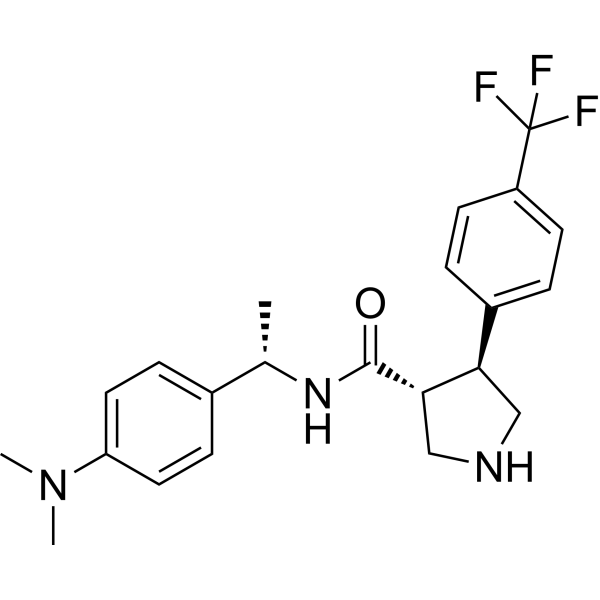
CWHM-1008
Based on 1 publication(s) in Google Scholar
CWHM-1008 is an orally active 4-arylpyrrolidine-3-carboxamide compound with both antimalarial and antiproliferative activities. CWHM-1008 inhibits Plasmodium falciparum. CWHM-1008 blocks the Akt/mTOR pathway in lung adenocarcinoma cells, inducing apoptosis and protective autophagy. CWHM-1008 inhibits the growth of Plasmodium falciparum and Plasmodium chabaudi ASCQ parasitemia in mice. CWHM-1008 inhibits the growth of lung adenocarcinoma xenograft tumors in mice. CWHM-1008 can be used for research on lung adenocarcinoma and malaria.
Nos produits utilisent uniquement pour la recherche. Nous ne vendons pas aux patients.
- Pureté : 99.24%
- CAS No.: 2362539-97-5
- Formule: C22H26F3N3O
- Masse moléculaire:405.46
-
Stockage:Powder -20°C, 3 years , 4°C, 2 years ; In solvent -80°C, 6 months , -20°C, 1 month

To place orders, for customer services and technical support, please contact: MedChemExpress USA
Tel: 609-228-6898 E-mail: [email protected] [email protected]


-
 Activité biologique
-
Chemical Information
-
Solvant et solubilité
- Protocole
- Pureté et documentation
- Références
-
 Help & FAQs


Publications Citing Use of MedChemExpress (MCE) CWHM-1008
MoreVoir tous les produits spécifiques à Isoform Parasite
MoreVoir tous les produits spécifiques à Isoform Caspase
More

Activité biologique
Description
IC50 & Target
[1]|
Plasmodium |
mTOR |
Akt |
Caspase 3 |
In Vitro
CWHM-1008 (2.5-10 µM; 10 days) inhibits colony formation in H358 and A549 LUAD cells[2].
CWHM-1008 (0-40 µM; 0-24 h) reduces the number of viable cells in H358 and A549 LUAD cells[2].
MedChemExpress (MCE) has not independently confirmed the accuracy of these methods. They are for reference only.
-
Cell Line:H358, A549, H1299, H827, and Beas-2b cells
-
Concentration:0, 5, 10, 20, 40, 80 µM
-
Incubation Time:24, 48, 72 h
-
Result:Inhibited viability of H358, A549, H1299, and H827 cells to varying degrees at 24 h.
Reduced H358 and A549 viability in a time-dependent manner.
Showed no significant viability change in Beas-2b cells.
-
Cell Line:H358 and A549 cells
-
Concentration:2.5, 5, 10 µM
-
Incubation Time:10 days
-
Result:Reduced clonogenic survival in H358 and A549 cells.
Decreased visible colony numbers versus control.
-
Cell Line:H358 and A549 cells
-
Concentration:20, 30, 40 µM
-
Incubation Time:0 and 24 h
-
Result:Decreased H358 and A549 cell numbers at 24 h compared with control.
-
Cell Line:H358, A549, and Beas-2b cells
-
Concentration:10, 20, 30 µM (H358
10, 20, 40 µM (A549, Beas-2b) -
Incubation Time:24 h
-
Result:Induced dose-dependent apoptosis in H358 and A549 LUAD cells but not in Beas-2b normal lung epithelial cells.
Had no obvious effect in Beas-2b cells.
-
Cell Line:H358 and A549 cells
-
Concentration:0, 20, 30 µM (H358)
0, 20, 40 µM (A549) -
Incubation Time:24 h
-
Result:Activated caspase-3/PARP apoptotic signaling in H358 and A549 LUAD cells.
Induced autophagy and blocks Akt/mTOR signaling in H358 and A549 LUAD cells.
-
Cell Line:H358 and A549 cells
-
Concentration:0, 30 µM (H358); 0, 40 µM (A549)
10 µM LY294002 (with CWHM-1008) -
Incubation Time:24 h
-
Result:Enhanced CWHM‑1008‑induced apoptosis in H358 and A549 LUAD cells was autophagy inhibition with LY294002 and CA‑Akt‑mediated Akt‑driven suppression of CWHM‑1008‑triggered autophagy.
Parmacokinetics
In Vivo
MedChemExpress (MCE) has not independently confirmed the accuracy of these methods. They are for reference only.
-
Animal Model:NIH (female, 5 weeks old, inoculated i.p. with 2 x 10⁷ parasitized (Plasmodium chabaudi ASCQ) red blood cells)
[1] -
Dosage:3 mg/kg/day; 10 mg/kg/day; 30 mg/kg/day
-
Administration:p.o.; once daily; 4 days
-
Result:Inhibited parasitemia by 22.4% at 3 mg/kg/day.
Inhibited parasitemia by 75.2% at 10 mg/kg/day.
Inhibited parasitemia by 98.7% at 30 mg/kg/day.
-
Animal Model:nude mice (female, 4 weeks of age; 5 × 10⁶ A549 cells were resuspended in 125 μL PBS with 50% Matrige)
[2] -
Dosage:15 mg/kg; 30 mg/kg
-
Administration:p.o. (gastric intubation); once every two days; for 20 days
-
Result:Inhibited the growth of A549 xenografts in nude mice in a dose-dependent manner.
Decreased the proliferation index Ki67.
Increased the apoptosis-related TUNEL index.
- Annexin V plus membrane-impermeant dye apoptosis staining
- Cell Viability Determination by MTT Colorimetric Assay
- Detection of Apoptosis
- TUNEL staining for apoptotic DNA fragmentation
- Autophagy
- Patient-Derived Xenograft (PDX)
- Apoptosis Solutions
- Splenic/Portal-Vein Liver Metastasis Xenograft
- Lysosome and acidic-vesicle live-cell staining
- Subcutaneous Cell-Line-Derived Xenograft
- Macroautophagy Solutions
- Orthotopic Cell-Line Xenograft
- Intraperitoneal/Peritoneal Dissemination Xenograft


Chemical Information
-
CAS No. 2362539-97-5
-
Appearance Solid
-
Masse moléculaire 405.46
-
Formule C22H26F3N3O
-
Color White to off-white
-
SMILES
C[C@H](NC([C@H]1CNC[C@@H]1C2=CC=C(C(F)(F)F)C=C2)=O)C3=CC=C(N(C)C)C=C3
-
Livraison
Room temperature in continental US; may vary elsewhere.
-
Stockage
Powder -20°C 3 years 4°C 2 years In solvent -80°C 6 months -20°C 1 month


Publications (1)
-
Journal Impact Factor
-
Most Recent
-
J Oncol
CWHM-1008 Induces Apoptosis and Protective Autophagy through the Akt/mTOR Axis in LUAD Cells. [Abstract]2021 Sep 11:2021:5548128. PMID: 35096055


Solvant et solubilité
In Vitro:
DMSO : 250 mg/mL (616.58 mM; Need ultrasonic; Hygroscopic DMSO has a significant impact on the solubility of product, please use newly opened DMSO)
Please refer to the solubility information to select the appropriate solvent. Once prepared, please aliquot and store the solution to prevent product inactivation from repeated freeze-thaw cycles.
Storage method and period of stock solution: -80°C, 6 months; -20°C, 1 month. When stored at -80°C, please use it within 6 months. When stored at -20°C, please use it within 1 month.
Concentration (start) × Volume (start) = Concentration (final) × Volume (final)
In Vivo:
Select the appropriate dissolution method based on your experimental animal and administration route.
- For the following dissolution methods, please ensure to first prepare a clear stock solution using an In Vitro approach and then sequentially add co-solvents:
- To ensure reliable experimental results, the clarified stock solution can be appropriately stored based on storage conditions. As for the working solution for In Vivo experiments, it is recommended to prepare freshly and use it on the same day.
- The percentages shown for the solvents indicate their volumetric ratio in the final prepared solution. If precipitation or phase separation occurs during preparation, heat and/or sonication can be used to aid dissolution.
Add each solvent one by one: 10% DMSO 40% PEG300 5% Tween-80 45% Saline
Solubility: ≥ 2.08 mg/mL (5.13 mM); Clear solution
This protocol yields a clear solution of ≥ 2.08 mg/mL (saturation unknown).
Taking 1 mL working solution as an example, add 100 μL DMSO stock solution (20.8 mg/mL) to 400 μL PEG300, and mix evenly; then add 50 μL Tween-80 and mix evenly; then add 450 μL Saline to adjust the volume to 1 mL.
Preparation of Saline: Dissolve 0.9 g sodium chloride in ddH₂O and dilute to 100 mL to obtain a clear Saline solution.
In Vivo Dissolution Calculator
Please enter the basic information of animal experiments:
-
-
-
-
Recommended: Prepare an additional quantity of animals to account for potential losses during experiments.
Please enter your animal formula composition:
-
%DMSO +
Recommended: Keep the proportion of DMSO in working solution below 2% if your animal is weak.
-
%+
-
+%Tween-80 + +
-
%Saline +
The co-solvents required include: DMSO, . All of co-solvents are available by MedChemExpress (MCE). , Tween 80. All of co-solvents are available by MedChemExpress (MCE).
Working solution concentration: 0.22 mg/mL
Method for preparing stock solution: mg drug dissolved in μL DMSO. Stock solution concentration: mg/mL.
1. Take μL DMSO stock solution;
2. Add μL .
μL , mix evenly;
3. Then add μL Tween 80, mix evenly;
4. Then add μL
Please ensure that the stock solution in the first step is dissolved to a clear state, and add co-solvents in sequence. You can use ultrasonic heating (ultrasonic cleaner, recommended frequency 20-40 kHz), vortexing, etc. to assist dissolution.


Pureté et documentation
-
Fiche technique (310 KB)
-
SDS (251 KB)
- English - EN (251 KB)
- Français - FR (251 KB)
- Deutsch - DE (251 KB)
- Norwegian - NO (251 KB)
- Español - ES (251 KB)
- Swedish - SV (251 KB)
- Italian - IT (251 KB)
- Korean - KR (251 KB)
- Portuguese - PT (251 KB)
-
Instruction de manipulation (2659 KB)
Références
[1]. Meyers MJ, et al. 4-Aryl Pyrrolidines as a Novel Class of Orally Efficacious Antimalarial Agents. Part 1: Evaluation of 4-Aryl- N-benzylpyrrolidine-3-carboxamides. Journal of medicinal chemistry. 2019 Apr 11;62(7):3503-3512. [Content Brief]
[2]. Zhang J, et al. CWHM-1008 Induces Apoptosis and Protective Autophagy through the Akt/mTOR Axis in LUAD Cells. Journal of oncology. 2021;2021:5548128. [Content Brief]


Complete Stock Solution Preparation Table
Please refer to the solubility information to select the appropriate solvent. Once prepared, please aliquot and store the solution to prevent product inactivation from repeated freeze-thaw cycles.
Storage method and period of stock solution: -80°C, 6 months; -20°C, 1 month. When stored at -80°C, please use it within 6 months. When stored at -20°C, please use it within 1 month.
| Optional Solvent | Concentration Solvent Mass | 1 mg | 5 mg | 10 mg | 25 mg |
|---|---|---|---|---|---|
| DMSO | 1 mM | 2.4663 mL | 12.3317 mL | 24.6633 mL | 61.6584 mL |
| 5 mM | 0.4933 mL | 2.4663 mL | 4.9327 mL | 12.3317 mL | |
| 10 mM | 0.2466 mL | 1.2332 mL | 2.4663 mL | 6.1658 mL | |
| 15 mM | 0.1644 mL | 0.8221 mL | 1.6442 mL | 4.1106 mL | |
| 20 mM | 0.1233 mL | 0.6166 mL | 1.2332 mL | 3.0829 mL | |
| 25 mM | 0.0987 mL | 0.4933 mL | 0.9865 mL | 2.4663 mL | |
| 30 mM | 0.0822 mL | 0.4111 mL | 0.8221 mL | 2.0553 mL | |
| 40 mM | 0.0617 mL | 0.3083 mL | 0.6166 mL | 1.5415 mL | |
| 50 mM | 0.0493 mL | 0.2466 mL | 0.4933 mL | 1.2332 mL | |
| 60 mM | 0.0411 mL | 0.2055 mL | 0.4111 mL | 1.0276 mL | |
| 80 mM | 0.0308 mL | 0.1541 mL | 0.3083 mL | 0.7707 mL | |
| 100 mM | 0.0247 mL | 0.1233 mL | 0.2466 mL | 0.6166 mL |


CWHM-1008 Related Classifications
HY-111746 Related Classifications
 Powered by Bioz
Keywords
- CWHM-1008
- 2362539-97-5
- CWHM1008
- CWHM 1008
- Parasite
- Akt
- mTOR
- Caspase
- PARP
- Autophagy
- Apoptosis
- PKB
- Protein kinase B
- Mammalian target of Rapamycin
- poly ADP ribose polymerase
- Akt/mTOR pathway
- Plasmodium chabaudi
- Plasmodium falciparum
- apoptosis
- autophagosome
- autophagy
- caspase-3/PARP
- cell proliferation
- lung adenocarcinoma
- malaria
- Inhibitor
- inhibitor
- inhibit